
City Fact Check
In today’s world, information on almost any subject is available at our fingertips from a variety of sources. Whether fact, fiction, opinion-based, or somewhere in-between, information travels quickly and sometimes can be contradictory, confusing and often overwhelming. So, in the interest of residents, businesses, and those with a vested interest in City business, the City has created this page to provide facts and accurate background information on some of the most widely discussed and compelling topics of the day. We hope you find it interesting and helpful!
-
Fact Check: West Shore RCMP Project Approval Timing
Share Fact Check: West Shore RCMP Project Approval Timing on Facebook Share Fact Check: West Shore RCMP Project Approval Timing on X (formerly Twitter) Share Fact Check: West Shore RCMP Project Approval Timing on Linkedin Email Fact Check: West Shore RCMP Project Approval Timing link
City Fact Check: West Shore RCMP Project Approval Timing
Incorrect Statement: There is ample time for municipal councils to review the project before the March Capital Regional District (CRD) meeting.
Fact Check: There are several mandatory approval steps required before and after the CRD Board adopts the Service Establishment and Loan Authorization Bylaws. The timing of these steps directly affects when the CRD can proceed with borrowing.
While the bylaws could be considered by the CRD Board on March 11, 2026 at the latest, several prerequisite approvals must occur before that meeting happens. These approvals typically require two to three months to complete.
Once all three municipal councils have approved the Validation Report and provided consent to the bylaws, the bylaws must be submitted to the Inspector of Municipalities for review. This review generally takes 8–10 weeks, and its timing is outside the CRD’s control.
After receiving Inspector approval, the CRD Board may adopt the bylaws. Adoption triggers a 30 day quashing period, during which the bylaws may be challenged. Once that period concludes, borrowing can proceed when the Certificate of Approval is issued by the Ministry of Municipal Affairs and Housing and the Municipal Finance Authority of BC completes the borrowing documentation. These post-adoption steps typically take about eight weeks.
In addition to these structured government timelines, and as noted in other fact checks regarding this project, there remains a risk of losing the existing IPD team to other projects due to uncertainty and delays.
These factors underscore the importance of securing approval from all municipalities by the end of January. Any longer than that risks missing the March CRD bylaw adoption window and will jeopardize the project.
-
West Shore RCMP Expansion Project
Share West Shore RCMP Expansion Project on Facebook Share West Shore RCMP Expansion Project on X (formerly Twitter) Share West Shore RCMP Expansion Project on Linkedin Email West Shore RCMP Expansion Project link
City Fact Check: West Shore RCMP Expansion Project
Incorrect Statement: The Validation Report is a “Template” or “Plagiarized”
Fact Check: Claims that the Validation Report was “templated” or “plagiarized” misrepresent both standard industry practice and the substantial, professional, project-specific work completed for the West Shore RCMP Facility Expansion.
Like most professional consulting documents, parts of the report use established templates and consistent industry language, especially in areas such as Integrated Project Delivery (IPD). This is standard and intentional. IPD uses common structures, terminology, and governance principles across projects so that roles, responsibilities, and processes are clear and aligned.What is unique, and developed specifically for this project, are the core elements of the report, including:
- the basis of design
- the cost model and budget
- site specific constraints
- the project's risk profile
- the phasing strategy
- the construction execution approach
All of these components were created through a detailed analysis, operational requirements, and input from project partners. None of these elements were copied from past projects.
Claims that the project’s Risk Register was copied from a different municipality’s project is also incorrect. The contractors involved in that project are not the same contractors working on the West Shore RCMP project, and there is no overlap or consistency between the two Risk Registers. Additionally, the West Shore RCMP project Risk Register is part of the RCMP’s technical review and has not yet been reviewed by the Owners Group.
The IPD Team contingency and the explanation of how IPD manages risk are included in the Council Validation Report. This clarifies that in IPD, if risks are realized and the team goes over budget as a result, the difference will come out of the IPD Team’s profits. The full Risk Register contains sensitive information and must remain within the complete Validation Report under RCMP security protocols. This unredacted version, which includes the Risk Register and other technical material, is part of the RCMP‑cleared Validation Report.
To clarify, this Validation Report was written by the IPD parties who are putting their profits at risk, as is appropriate in IPD. In this project, Colliers Project Leaders serves as the Owner’s advisory team and is not a signatory to the contract; therefore, they are not the authors of this report.
Incorrect Statement: There is a “Missing Floor” That Was Promised as Part of The Project
Fact Check: During the Validation Study, which is the conceptual design stage of an IPD process, several building layouts were explored to find the most efficient and cost effective structure while meeting post disaster building code requirements.Early in the Study, the draft program included a forensics lab and additional areas intended to support long-term growth. The project team was asked to test how much space could be accommodated within the approved $87.5 million budget. Both RCMP E-Division and the local RCMP leadership were involved in these discussions, as they must approve designs for all RCMP facilities.
Toward the end of the Validation Phase, it was shared by the RCMP that they could not commit to a forensics lab for this location, so it was removed from the program. Additionally, the updated population projections from BC Stats were confirmed, which reduced the Full Time Equivalent RCMP headcount and corresponding square footage requirements. These two main factors resulted in a total area reduction required for the program. The IPD team, including the Owner Representatives, carefully considered this information and confirmed that holding an additional floor of space for growth beyond 25-years was not feasible within the $87.5 million budget.
To stay within the approved funding, the building was right sized through:
- removing the forensics lab per RCMP
- reducing the amount of future growth space
- relocating mechanical units to the roof, which allowed the structure to be reduced from the early six-storey concept to a five-storey design
- recovering inefficient floor area due to the change from concrete to steel structure
- the optimization of the remaining total floor plate to meet RCMP requirements
The RCMP has reviewed and validated that the design still supports 25-years of operational growth.
All this information was shared with the Chief Administrative Officers (CAO), at the CAO alignment meeting on November 20, 2025, confirming that the project team was proceeding correctly and that the validation parameters had been met.
There is no missing floor, only fiscally responsible design adjustments made to align with future projections, ensure the project meets operational needs and stays within the approved budget.
Incorrect Statement: There is no Project Leadership
Fact Check: The IPD contract model is intentionally designed so that leadership is shared rather than assigned to a single project manager. This is because project success under IPD is based on shared outcomes, not individual performance, and decisions are made collectively by the parties who share both risk and reward. The joint governance structure aligns authority with accountability, allowing the team to make real time, best for project decisions across design, cost, schedule, and operations. This shared structure is fundamental to how IPD works.Each company that signs the single contract appoints a leader to sit on the Project Management Team (PMT). The PMT is supported by oversight from a Senior Management Team (SMT). The Owners participate directly as an equal member of this process.
For the West Shore RCMP Facility project, the PMT member is a staff member from Colwood, and the SMT member is the CAO from View Royal, acting as the Owners primary representative for the partnering municipalities.
In IPD projects, including this one, there is also an Owner’s IPD Advisor who provides guidance and coaching to help the team work effectively within this collaborative contract structure. Colliers fulfills this role. Colliers is not an IPD partner in this particular project, but an extension of the Owners team, helping guide the execution of the IPD model. This requires deep knowledge of the project because the model shifts how resources are mobilized and how teams work together throughout design and construction.
This shared leadership structure is intentional and is a key reason IPD projects are able to make coordinated, efficient, and best for project decisions.
Incorrect Statement: IPD is Good in Theory but not Reinforceable and it is Essentially a “Fixed Contract”
Fact Check: A comment was made suggesting that IPD is essentially a fixed contract. This is incorrect and reflects a misunderstanding of the IPD model.IPD is a relational contract model. Instead of setting a fixed price, it establishes a Target Cost and a Profit Pool. If costs rise, typical overruns are absorbed by the Profit Pool, not by the Owner. The Profit Pool is placed at risk, meaning the non-owner partners only earn their full profit if the project performs well. In IPD, the entire team works together to complete the project under budget, and any savings are shared between the Owner and the non-owner participants.
IPD allows for very limited and specific conditions where a budget change is acceptable. These include Owner directed added scope to meet a higher performance requirement, a change in law that occurs after validation, and significant unforeseen conditions that require discussion to determine how that risk should be shared between the Owner and the non-owner participants.
There continues to be misunderstandings that IPD is the same as some other contract types that have collaboration elements integrated, however, IPD has a different contract structure and governance practice. IPD is the model most well known for removing the barriers that exist in traditional contracting approaches by placing full profit at risk, using the highest level of transparency, and enabling agile multi-disciplinary teams to innovation and problem solve.
From an Owner’s perspective, IPD itself is a risk mitigation strategy. The team, including consultants and contractors, collectively review all project elements during Validation and jointly develops strategies to manage risk, without being limited by the separation of roles that typically exists in other models.
Because liabilities are waived except in cases of willful negligence, the likelihood of claims or litigation is significantly reduced. If issues arise, they are addressed through the project’s governance structure, which includes clear processes for resolving concerns and, if necessary, removing parties from the team. These processes are directly outlined in the contract.
IPD is not theoretical, nor is it a fixed contract. It is a tested, enforceable, highly collaborative model that aligns incentives, increases transparency, and reduces risk for all participants.
Incorrect Statement: There is no Risk to Wait to Approve This project
Fact Check: The IPD Team members who sign the Validation Report include highly specialized professionals who have been integrated into a high-performance team. If the project approval is delayed, these individuals may need to be reassigned to other work, and some may no longer be available or willing to sign on to the commitments outlined in the Validation Report.Delaying Validation Report approvals has significant schedule implications. If too much time passes, the IPD Team may need to re-validate the work before signing the contract and moving into project execution. There is no set time frame for when re-validation becomes necessary, but most Owners move quickly after Validation to take advantage of team momentum, innovation, and cost saving opportunities. For the West Shore RCMP project, the plan in the Validation Report anticipated Detailed Design beginning in February 2026, and demolition starting in May 2026. If approval is delayed by two to three months, the Validation Report would likely need to be re-validated, subject to confirmation by the IPD signatories.
A concern in an IPD environment is stability on the Owner’s side. Non-owner participants must choose to sign the contract, and if they perceive uncertainty, misalignment, or significant gaps in understanding within the Owners group, they may decline to proceed. Recent public discussions have indicated confusion about fundamental IPD governance and processes, despite the multi-year investment the Owners group has made in developing this expertise. This creates a real risk that some non-owner participants may choose not to sign the final contract if instability continues.
In short, delays create risks to cost certainty, schedule, team continuity, and the willingness of key partners to proceed. These risks increase the longer approval is postponed.
Incorrect Statement: Langford Should Wait on the “Additional” Validation Report, the Existing Validation Report is Not Complete
Fact Check: The Validation Report represents the formal commitment from the IPD non-owner members to the Owner team. It provides clear scope definitions that outline the required performance standards, a clear budget with profit placed at risk, and a delivery schedule that maintains RCMP operational continuity.The more detailed “additional” or “full” Validation Report being referenced is subject to standard RCMP security protocol. It can only be reviewed by individuals who hold Enhanced Reliability Status (ERS), because it contains technical details and sensitive information related to RCMP facility requirements. Although this report is more detailed, it is fully aligned with the Council Validation Report and does not change the scope, budget, or delivery parameters that were presented to Council.
The IPD team contingency and the explanation of how IPD manages risk were included in the Council Report. The full Risk Register, however, contains sensitive information and therefore must remain within the full Validation Report under RCMP security protocols.
The technical information in the full Validation Report also required additional review to ensure consistency with the RCMP Project Management Manual.
It is important to note that all RCMP projects require similar security measures, whether they use IPD or a different contract model. This applies to RCMP projects across British Columbia and nationally. Security clearance requirements exist because these facilities have sensitive operational information, and strict protocols define who may review it and how it can be shared.
Incorrect Statement: The Validation Approval (Go/No-Go) Phase is Time for Detailed Scrutiny
Fact Check: In IPD, the Owners participate directly at the table as part of the IPD team throughout the entire Validation phase. Because the Owner is embedded in the work from start to finish, and information is shared transparently, the approval point at the end of Validation functions typically as a confirmation rather than a new stage of scrutiny. This is how the IPD process is designed to work.For the West Shore RCMP project, this approach relied on confidence in the Owner representatives who sat on the SMT, and PMT. These representatives participate as members of the IPD team and are responsible for ongoing communication back to their respective councils.
This process was operating effectively until changes in communication consistency began to emerge in the spring of 2024, coinciding with a transition in the CAO role at the City of Colwood. The previous CAO had been deeply involved in the historical work that shaped the IPD onboarding and model. After his retirement, it became clear that there were gaps in understanding related to the foundational processes that had been developed over several years. A structured onboarding process was created to support the newly appointed CAO to align them with the other municipal CAO’s.
Throughout this period, the Owner group continued to have a PMT representative (from Colwood) embedded within the IPD team, along with a SMT representative (from View Royal) who held the appropriate RCMP security clearance and engaged directly with the project on behalf of the municipalities. These representatives consistently received information and participated in decision making throughout Validation. Reports and information sessions with the CAO’s occurred during Validation with the expectation that CAO’s would keep their council’s updated. The CAO meetings culminated in the CAO Validation alignment session on Nov 20, 2025, which verified that the Validation parameters were met.
Given that communication to councils seems to be inconsistent, and that some councils do not appear to have been regularly informed about the IPD process or its progress, it is understandable that questions and confusion are now emerging. However, many of these concerns are rooted in assumptions associated with traditional contracting approaches rather than in how IPD functions.
Incorrect Statement: The Project is Over Budget on the Validation Phase Spending, Possibly Overpaying ConsultantsFact Check: The Validation phase is not a fixed budget activity. It is a study period, similar to a feasibility study, where the team examines how to best achieve the project’s requirements while analyzing stakeholder needs, schedule implications, and budget impacts. For a complex RCMP facility that involves both a new build and renovation, this work is extensive and requires careful coordination.
In early 2023, guidance was provided and the Owner’s group selected that the 1.5% of the total project budget would be originally set aside for Validation. This was the lowest percentage provided in the range of guidance compared to typical IPD projects in North America. The IPD Advisor, an expert brought on in 2024 to provide guidance on project delivery, clarified that, given the unique operational and security requirements of an RCMP facility, the Validation phase should represent approximately 2.5% to 3% of the total project budget. At that time, the Owner team chose to proceed at 2% of the total project budget and assess progress as the work unfolded.
Validation formally began in February 2024. By March 2024, the IPD team had identified significant challenges and constraints, and discussions began with CAO leadership about the budget gap for the Validation study period. A transition in CAO leadership occurred in Colwood during this period, which affected the timing and resolution of these discussions.
In May 2024, work was paused at the request of Colwood and supported by Langford and View Royal to allow for a ‘check-to-proceed’, including a detailed review of the IPD Team’s work to confirm the direction and value was there for the Owner’s group to proceed. A joint Council presentation including Langford, Colwood, and View Royal was hosted by the West Shore RCMP Officer In Charge (OIC) in July 2024, where the team provided a full technical update on scope, cost, and schedule. The presentation was well received, and approvals followed, with the final approval to ‘proceed with completing Validation’ occurred in late September by each of the Council’s. Because of this pause, the team had nearly four months of downtime before being able to reassemble and complete the remaining Validation work.
The pause in work caused delays and required the team to redirect focus from problem solving to responding to process‑related concerns. Despite this, the team worked to recover time and stay on track.
Throughout Validation, the IPD team has been highly conscious of time spent and has tightly managed resources to stay within the revised expectations of $2.1M in Validation Spending. This is still considered on the low end for a project of this nature, as the technical demands of this project are significant to ensure design meets RCMP requirements within the budget and operational continuity constraints.
During Validation, none of the IPD partners receive any profit, because their profit is placed at risk from the start of Validation. They are paid only for the work completed, not for results they have not yet delivered. Their profit is earned only if the project performs within the validated parameters.
This Validation process is unique to this particular IPD team and reflects the commitments they have made within the shared governance structure. Allegations of overpayment misunderstand both the nature of Validation and the risk‑based structure of IPD.
Incorrect Statement: The Design Was “Manipulated”
Fact Check: The entire Owner team, including all municipal CAOs, asked the IPD team to evaluate every reasonable site layout option to ensure best value for the project. This included a brief review of alternate configurations such as shifting the building footprint or splitting the building into two structures. These options were assessed early in the Validation study and ruled out because they were not preferred by the RCMP, would disrupt operational flow, and would hinder the ability to plan a future phased expansion approximately 25-years from now.The City of Langford did request a review of a setback building to address concerns about visibility along the street frontage. However, after testing this option, the team confirmed that the combination of site size, the functional requirements provided by the RCMP, and operational flow needs meant that the proposed layout was the only feasible option unless significant additional funding was provided to build an underground parkade.
Claims that this evaluation process was inappropriate or were manipulated are factually incorrect. In an IPD environment, it would be irresponsible for the team not to explore all reasonable options before confirming the preferred solution.
Throughout the Validation phase, the RCMP and all municipal CAO’s were kept informed of the conceptual design exploration process. Every option was examined transparently, documented appropriately, and evaluated against the operational, financial, and long-term needs of the West Shore RCMP.
There was no manipulation, only responsible due diligence consistent with the expectations of an IPD model.
-
Fact Check: Veterans Memorial Park Expansion Funding Source
Share Fact Check: Veterans Memorial Park Expansion Funding Source on Facebook Share Fact Check: Veterans Memorial Park Expansion Funding Source on X (formerly Twitter) Share Fact Check: Veterans Memorial Park Expansion Funding Source on Linkedin Email Fact Check: Veterans Memorial Park Expansion Funding Source link
Incorrect Statement: The Veterans Memorial Park expansion is funded by taxation and will raise taxes.
Fact Check: The project is paid for by Parks Development Cost Charges (DCCs), fees collected from new development, not by property taxation or City surplus. It will not raise taxes or use taxpayer funds. -
Fact Check: Safe Routes to School
Share Fact Check: Safe Routes to School on Facebook Share Fact Check: Safe Routes to School on X (formerly Twitter) Share Fact Check: Safe Routes to School on Linkedin Email Fact Check: Safe Routes to School link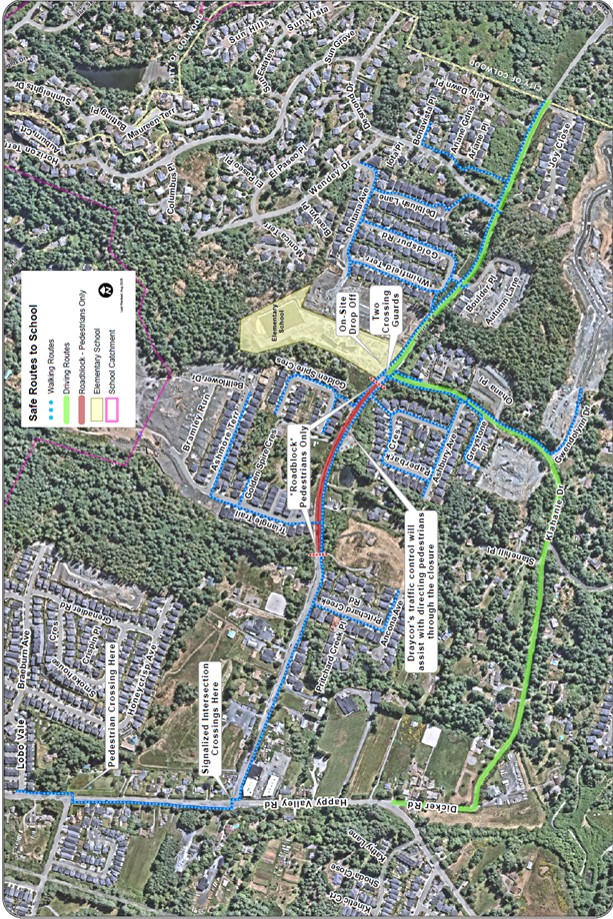
Incorrect Statement: Latoria Road will not be open for students to walk, roll, or ride to school on September 2, 2025
Fact Check: Latoria Road will be open to transit and active transportation modes (walk, roll, or ride) on September 2, 2025 but not personal vehicles in the construction zone for at least another 4 weeks due to subgrade issues and BC Hydro delays.
Since 2023, Langford Council has prioritized safe routes to school and has taken significant action to improve active transportation infrastructure across the community. Budget decisions in 2023 and 2024 accelerated the City’s Sidewalk Infill Program by more than a decade. Over the past three years, more than $15 million from various funds has been committed to sidewalk infill projects, protected multi-use paths, protected bike lanes, traffic calming, and intersection safety improvements. This approach is helping set new standards for community safety and accessibility as the city continues to grow.
One of the key priorities for 2025 was Phase 1 of the Latoria Active Transportation Project around the new SĆIȺNEW̱ SṮEȽIṮḴEȽ Elementary School. Langford Council committed up to $8.5 million (reduced to $6.4 million) for upgrades to Latoria Road, with construction approval ahead of grant funding confirmation. Through detailed design, over $2 million in cost savings were found; however, accelerating the widening of a long old stretch road between Pritchard Creek and BC Hydro Poles has been challenging. Regardless, students will be able to walk, ride, or roll their way to their new school on September 2nd. Please follow the maps, signage, crossing guards, and site personnel’s instructions.
Additionally, as part of the preparations for the opening of the new SĆIȺNEW̱ SṮEȽIṮḴEȽ Elementary School, the City recognized that residents of McCormick Meadows would need safe active transportation connections to the school. In response to community feedback, the City has also constructed a protected multi-use path including a new crosswalk with pedestrian activated flashers at Luxton Road to provide a safe active transportation route for students in the McCormick Meadows area.
Another key initiative for 2025 includes providing Langford’s oldest school, Millstream Elementary (established in 1959), with a complete sidewalk connection along Hoylake Avenue (from Treanor to Millstream) for the first time in the school's history. This project will also introduce significant safety enhancements at the school frontage and a raised crosswalk. Over the past three years, similar upgrades have been implemented at other local schools—including Ruth King Elementary, Spencer Middle School, Savory Elementary, Happy Valley Elementary, and Lakewood Elementary—across ten different streets.
These investments reflect Council's ongoing commitment to public safety, equity, sustainability, and the creation of secure, inclusive neighbourhoods for all residents. The City's future infrastructure initiatives, will be guided by the Active Transportation Plan and Transportation Master Plan, as identified in Council’s 2023-2027 Strategic Plan. These plans will support the development of safe and accessible routes for students and families, and encourage walking, cycling, and active travel throughout Langford. Phase 2 of public engagement for these plans begins this fall.
Investment Highlights
Safe routes to school and active transportation safety investment highlights since 2023 include:
• A new signal light at Latoria Road and Klahanie Drive, with a separated multi-use path and sidewalk extension on Klahanie Drive, and frontage improvements for SĆIȺNEW̱ SṮEȽIṮḴEȽ Elementary School.
• A new sidewalk and protected bike lanes on Latoria Road (from Pritchard Creek Road to Whimfeild Terrace – Phase 1) to SĆIȺNEW̱ SṮEȽIṮḴEȽ Elementary School.
• A protected multi-use path on Happy Valley Road and Latoria Road (from Lobo Vale to Pritchard Creek Road), connecting McCormick Meadows to SĆIȺNEW̱ SṮEȽIṮḴEȽ Elementary School.
• A sidewalk infill on Happy Valley Road and Englewood Avenue to Happy Valley Elementary School.
• A protected multi-use path on Bellamy Road from Bellamy Link to Treanor Avenue with intersection safety improvements.
• A complete sidewalk along Hoylake Avenue with a raised crosswalk and frontage improvements for Millstream Elementary School, including a multi-use path and formalized parking.
• A sidewalk extension on Treanor Avenue from City Gate Boulevard to Lakewood Elementary School.
• A sidewalk infill on Atkins Avenue to the Savory Elementary School bridge.
• All ages and abilities active transportation safety upgrades at Goldstream Avenue and Veterans Memorial Parkway (VMP).
• A sidewalk infill on Goldstream Ave between Spencer Middle School and Ruth King Elementary, including frontage improvements on Matson Road with a multi-use path, kiss-and-go drop of lane, and formalized parking.
• Protected bike lanes on Goldstream Avenue and Jacklin Road with new pavement and intersection improvements.
• A sidewalk extension on Goldstream Avenue east of St. Anthony’s Medical Centre to the bus stop west of Vantilburg Crescent.
Learn More:
• Visit Transportation Master Plan (TMP) and the Active Transportation Plan (ATP) to learn more about Langford Council’s plans to shape the future of transportation in Langford.
• Visit Latoria Road Active Transportation Project | Let's Chat Langford to stay up-to-date about the Latoria sidewalk project.